Starting a ski journey in the United States can feel exciting and intimidating at the same time, especially if your only reference point is watching experienced skiers move confidently down steep slopes. The reality is very different once you choose the right environment. Beginner friendly resorts are designed to remove pressure, simplify the learning process, and help you build confidence step by step without feeling overwhelmed.
What most first time skiers do not realize is that your experience is shaped far more by the resort you choose than by your natural ability. A resort with wide, gentle terrain, well organized learning areas, and strong instruction can make your first trip feel smooth and enjoyable. The wrong resort can make the same trip feel frustrating and discouraging even if the scenery is beautiful.
This guide is built to help you choose the best skiing resorts for beginners in the U.S. in a way that actually improves your experience. It focuses on how to decide, where to go, what to expect, and how to structure your first trip so that you progress naturally instead of feeling stuck or overwhelmed.
How to Choose the Best Beginner Ski Resort
If you want a simple way to decide, focus on three factors first: terrain, layout, and instruction quality. The best beginner resorts offer a high percentage of green runs that are wide, gently sloped, and easy to repeat. They place these runs near the base so you can practice without complicated navigation. They also invest heavily in ski schools, which helps you learn faster and with more confidence.
Equally important is how the resort feels when you are there. A beginner friendly resort is not rushed or chaotic. It gives you space to learn, clear directions on where to go, and an environment where you can make mistakes without feeling pressured.
What Makes a Ski Resort Truly Beginner Friendly
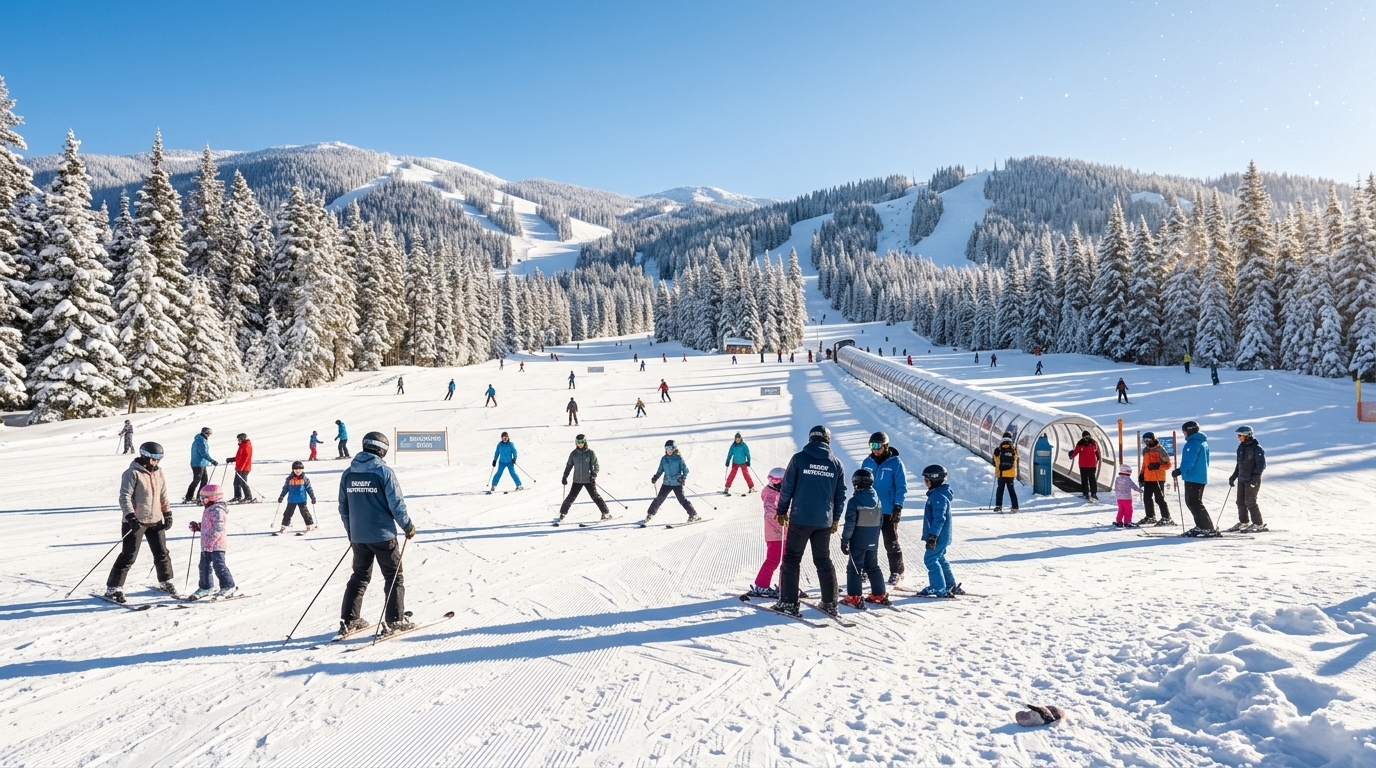
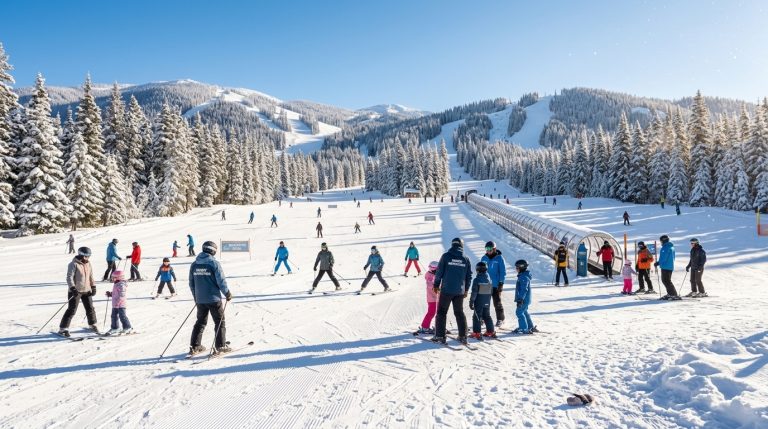
A beginner friendly ski resort is not defined by a single feature. It is the combination of several elements working together. Terrain is the most obvious one. Wide and gentle slopes allow you to focus on balance and control instead of simply trying to slow down. But layout matters just as much. Resorts that place beginner areas close to the base reduce the stress of getting around and make it easier to repeat runs without long lifts or confusing routes.
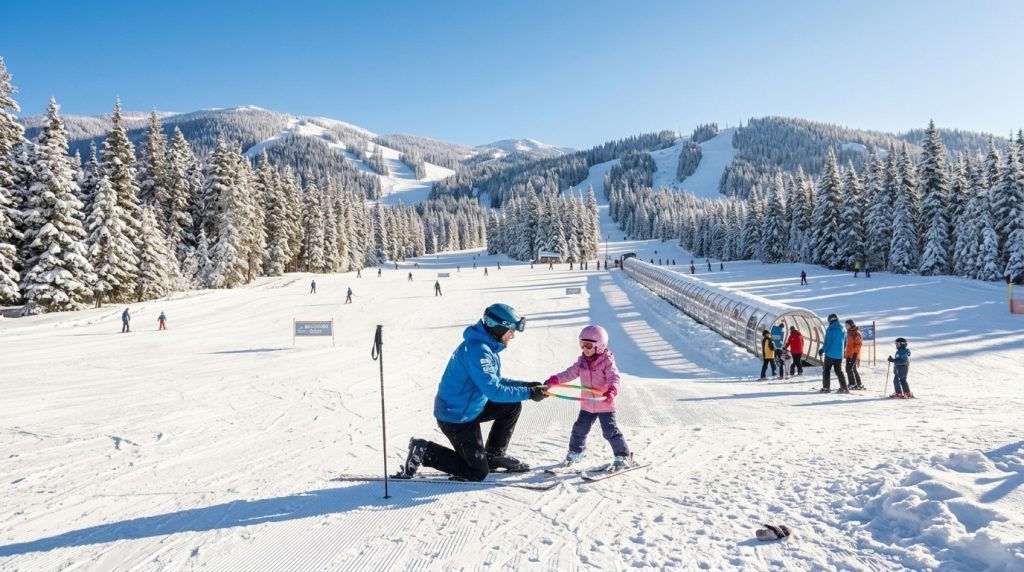
Instruction quality is another major factor. Resorts that invest in structured lessons, clear progression systems, and experienced instructors tend to produce a much better experience for first time skiers. You are not just learning how to stand on skis. You are learning how to move, stop, turn, and build confidence in a way that feels manageable.
The overall atmosphere also plays a role. Some resorts feel busy and fast paced, while others feel calmer and more supportive. Beginners almost always benefit from the latter because it reduces pressure and allows you to focus on learning.
Beginner Resort Comparison Framework
To make your decision easier, think of beginner resorts in three categories based on how they support progression.
Easy access resorts focus on convenience. These are places where everything is close together, lessons are easy to join, and navigation is simple. They are ideal for first time trips.
Progression focused resorts combine beginner terrain with longer green runs and structured learning zones. These are best if you want to improve quickly over a few days.
Premium beginner resorts offer the same learning environment but with better grooming, service, and overall comfort. These are ideal if you want a smoother and more refined experience while learning.
Best Ski Resorts for Beginners in the U.S.
Keystone, Colorado
Keystone is one of the strongest progression resorts for beginners in the United States because it allows you to grow into skiing without feeling rushed. The dedicated learning areas are large and well separated from advanced terrain, which reduces pressure. One of its biggest advantages is the long green run from the top of the mountain, which gives beginners the chance to experience a full descent without steep sections.
This type of layout helps you transition from basic practice to real skiing more naturally. Instead of staying on short slopes, you begin to understand how the mountain works as a whole.
Park City Mountain, Utah
Park City works well for beginners because it combines accessibility with scale while still maintaining clear learning zones. Even though the resort is large, the beginner areas are well designed and easy to navigate. This allows you to learn in a controlled environment before exploring more of the mountain.
Its proximity to Salt Lake City also reduces travel complexity, which is an important advantage for first time ski trips where simplicity matters.
Breckenridge, Colorado
Breckenridge stands out for its wide, forgiving beginner terrain, especially on the lower sections of the mountain. The slopes here are ideal for practicing turns and building confidence because they give you enough space to make mistakes without feeling restricted.
The resort also offers a strong ski school system, which makes it easier to progress from complete beginner to a more confident skier within a few days.
Beaver Creek, Colorado
Beaver Creek is often considered one of the most comfortable learning environments in the U.S. The slopes are carefully maintained, the crowds are generally more controlled, and the overall experience feels more organized. This reduces the small frustrations that can make learning harder than it needs to be.
For beginners who value a smoother and more structured experience, Beaver Creek is one of the best choices available.
Deer Valley, Utah
Deer Valley offers one of the most refined beginner experiences in the country. The grooming quality is exceptional, which makes the snow feel more predictable and easier to manage. The layout is also clear, which reduces confusion when moving between areas.
While it sits at a higher price point, the ease of learning and overall comfort can make it worth considering, especially for first time skiers who want the process to feel as smooth as possible.
Best Skiing Resorts for Beginners in the U.S.
Best Budget Friendly Beginner Resorts
Loveland Ski Area, Colorado
Loveland is one of the best budget options for beginners because it focuses on skiing rather than resort extras. Lift ticket prices are lower than major Colorado resorts, and the beginner areas are well designed and easy to access. The overall atmosphere is less crowded and more relaxed, which helps new skiers feel more comfortable.
Ski Cooper, Colorado
Ski Cooper offers a slower and quieter experience that is ideal for learning. The slopes are not intimidating, the crowds are lighter, and the entire environment feels more manageable for first time skiers. This makes it one of the best places to build confidence without pressure.
Brian Head Resort, Utah
Brian Head provides a strong balance between cost and quality. The layout is straightforward, the terrain is beginner friendly, and the overall experience is less intense than larger resorts. It is a practical choice for those who want to learn without overspending.
Beginner Trail Maps Explained for Visual Learning
Understanding trail maps is one of the fastest ways for beginners to feel more confident before even stepping onto the snow. Every ski resort uses a color system to indicate difficulty, and learning how to read this properly helps you choose runs that match your ability instead of guessing once you are already on the mountain. Green runs are designed for beginners and are usually wide, gently sloped, and forgiving. Blue runs are intermediate and introduce steeper terrain and more variation. Black runs are advanced and are not suitable for beginners.
When you look at a trail map, do not just focus on the colors. Pay attention to where beginner areas are located. The best resorts place green runs near the base or connect them in a way that allows you to move around without needing to use advanced terrain. Look for long green runs rather than short isolated ones. These allow you to practice continuously instead of stopping and restarting too often.
Another useful detail is lift placement. Beginner friendly resorts often have lifts that serve only green terrain, which means you can ride up and ski down without worrying about ending up somewhere too difficult. When you review a trail map before your trip, try to visualize a simple loop of green runs that you can repeat. This mental preparation makes your first day feel much more controlled and less confusing.
Lesson Cost Breakdown and Booking Strategy
Ski lessons are one of the best investments you can make as a beginner, but they are also an area where costs vary widely depending on the resort and type of lesson. Group lessons are usually the most affordable option and can range from around one hundred to three hundred dollars per day depending on the resort. Private lessons are significantly more expensive and can range from five hundred to over one thousand dollars per day at premium resorts.
The value of a lesson comes from how much faster you improve. A good instructor helps you avoid common mistakes, build correct habits early, and gain confidence much faster than learning on your own. This often means you enjoy your trip more and make better use of your lift ticket.
Booking strategy matters just as much as the lesson itself. Booking in advance is almost always cheaper and guarantees availability, especially during busy periods. Morning lessons are often the best choice because they give you time to practice what you learned throughout the rest of the day. Multi day lesson packages can also offer better value and a more structured progression compared to single day bookings.
If you are trying to balance cost and value, group lessons at a well regarded resort usually provide the best overall experience for beginners.
Best Beginner Resorts by State Cluster
Breaking resorts down by region or state helps you choose a destination that is both practical and beginner friendly without overcomplicating your travel plans.
In Colorado, Keystone, Breckenridge, and Beaver Creek are among the strongest choices for beginners. Keystone is particularly good for progression, while Beaver Creek offers a more refined and comfortable learning environment. Loveland and Ski Cooper provide more budget friendly alternatives with strong beginner terrain.
In Utah, Park City and Deer Valley stand out for their combination of accessibility and quality instruction. Brian Head offers a more affordable option with a simpler layout that works well for first time skiers.
In California, resorts like Heavenly and Northstar provide beginner friendly terrain along with scenic views, while smaller resorts in the Lake Tahoe area can offer better value and fewer crowds.
In the Northeast, resorts such as Sunday River in Maine and Mount Snow in Vermont are known for their approachable terrain and well developed ski schools. These regions are often easier to reach for travelers on the East Coast and can provide a strong introduction to skiing without requiring long travel.
In the Midwest, places like Boyne Mountain in Michigan and Granite Peak in Wisconsin are excellent for beginners who want to learn closer to home. While the terrain is smaller than western resorts, the learning environment is often less intimidating and more affordable.
Choosing a resort within a reachable region reduces travel complexity and allows you to focus more on the experience itself rather than the logistics of getting there.
Best Beginner Resorts by Budget Tier
For lower budgets, smaller resorts like Ski Cooper, Loveland, and Brian Head offer the best value because they focus on the essentials without premium pricing.
For mid range budgets, resorts like Keystone, Park City, and Breckenridge provide a strong balance between cost and experience, allowing you to access better terrain and instruction while still managing your budget.
For higher budgets, resorts like Beaver Creek and Deer Valley offer a more refined experience where the learning environment feels smoother, more organized, and less stressful overall.
Where to Stay as a Beginner
Where you stay has a direct impact on how easy your trip feels. Staying close to the base area reduces travel time, simplifies your daily routine, and makes it easier to attend lessons without stress. This is especially important on your first trip when everything is still unfamiliar.
A simple, well located accommodation often provides more value than a luxury stay farther away. Convenience reduces friction, and less friction makes learning easier.
What to Expect on Your First Ski Trip
Your first day will likely feel unfamiliar, and that is completely normal. You will spend time learning how to move, stop, and control your speed. These basics take time, but progress often comes faster than expected once you start practicing.
By the second day, many beginners begin to feel more stable and comfortable on green runs. By the third day, you may start to explore longer slopes and build confidence in your movements. The key is not to rush. Progress happens naturally when you stay within your comfort zone and build from there.
Beginner Progression Roadmap
Day one is focused on fundamentals. You learn balance, stopping, and basic turning, usually with an instructor.
Day two builds confidence. You spend more time on green runs, repeating movements until they feel more natural.
Day three introduces progression. You begin to link turns more smoothly and explore slightly longer runs without feeling overwhelmed.
This simple progression is what turns a first trip into a successful one.
Sample 3 Day Beginner Ski Trip Plan
On the first day, arrive early, rent your gear, and take a lesson. This sets the foundation for the rest of the trip. The second day focuses on practice and repetition, allowing you to build confidence without pressure. The third day is for progression, where you begin to explore more of the beginner terrain and feel more independent.
This structure keeps the experience focused and manageable.
Tips for Beginner Skiers
Take a lesson early instead of trying to learn on your own. Dress in layers so you can adjust to changing temperatures. Start on beginner slopes and progress gradually instead of rushing to more difficult terrain. Take breaks when needed to avoid fatigue, because tired legs often lead to mistakes.
The goal is steady improvement, not speed.
Common Mistakes Beginners Should Avoid
Choosing the wrong resort is one of the biggest mistakes beginners make. A resort with limited beginner terrain or a complex layout can make learning much harder than it needs to be. Skipping lessons is another common mistake, as it often slows progress and increases frustration.
Trying to move too quickly to harder terrain can also reduce confidence. Staying within your level and progressing gradually almost always leads to a better experience.
FAQ
What is the best ski resort for beginners in the U.S.?
Resorts like Keystone, Park City, and Breckenridge are among the most recommended because they combine beginner terrain with strong instruction.
How many days does it take to learn skiing?
Most beginners begin to feel comfortable after two to three days with proper instruction and practice.
Is skiing hard for beginners?
It can feel challenging at first, but the right environment and guidance make it much easier to learn.
Should beginners rent or buy ski gear?
Renting is usually the best option because it is more practical and allows flexibility.
Conclusion
The best skiing resorts for beginners in the U.S. are the ones that make learning feel natural, structured, and enjoyable. When you choose the right resort, focus on progression, and plan your trip carefully, skiing becomes far more accessible than it first appears.
Starting in the right place does not just make the first trip better. It sets the foundation for everything that follows.